
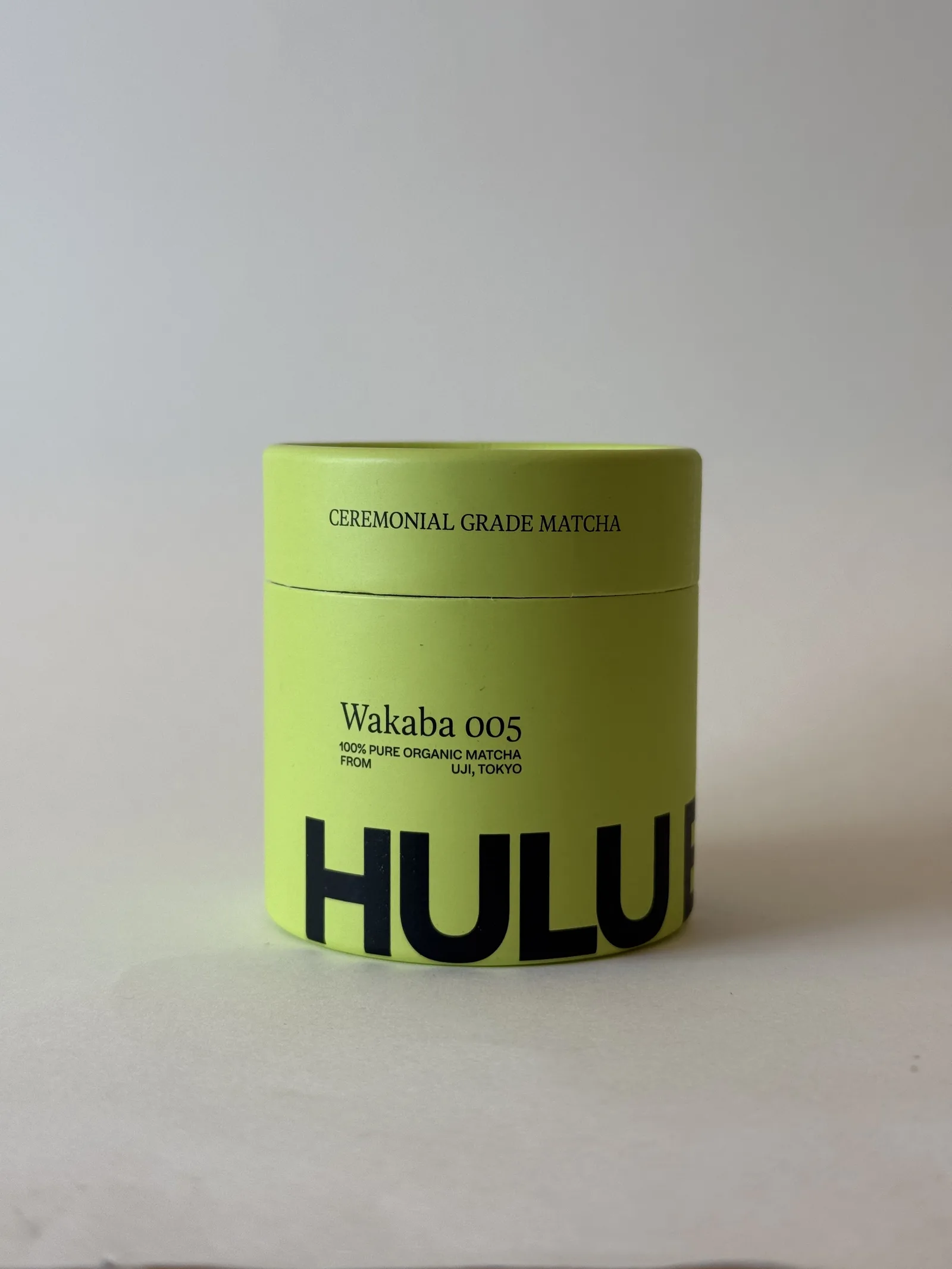
Daily · First and second harvest blend — early-summer flush chosen to hold vibrant green through baking and milk
Wakaba
Early-summer brightness. Vegetal, quick, everyday.
01bright and grassy
02quick, clean finish
03holds up in milk and heat
Wakaba is the workhorse — an early-summer Uji flush, ground to the finest powder of the four sealed tins. What makes it useful is not delicacy but durability: it holds its colour and its character through steamed milk, through ice, and through the oven, which is more than most ceremonial grades manage. Put a delicate koicha grade under sixty millilitres of oat milk and it vanishes; Wakaba is still recognisably itself. That is why it is the tin we pour for milk drinks at the bar and the one we recommend to cafés running forty lattes a day. Grass-forward on the nose, quick and clean on the finish. Not the most contemplative bowl on the card — the most useful one.
Not for
Not the grade for a slow, meditative bowl on its own — it's built to hold up inside a latte or a bake, not to be the star of a quiet pour. Reach for Rikyu or Hikari for that.
Umami
Bitter
Finish
RM 90
30g tin · ships across Malaysia
The batch
Traceable to the field.
Origin
Uji, Kyoto, Japan
Cultivar
Blended — Yabukita and Okumidori, balancing bold green-tea structure against smooth umami
Harvest
First and second harvest blend — early-summer flush chosen to hold vibrant green through baking and milk
Mill
Traditional stone-milled in Uji, Japan. Sealed at origin.
Micronage
10–14 microns
Tin size
30g tin
10–14 microns — fine enough to hold a stable foam under milk without turning gritty, and the finest grind of the four sealed tins.
Fresh, crafted. Never rushed.
Spec last reviewed
Where these numbers come from
- Origin · Cultivar · Harvest
- Per supplier batch sheet from the Uji-region co-op (on file at HULU BLAVK).
- Mill · Micronage
- Uji-milled grades: per the supplier's stone-mill QC log. Ritual 003 line: measured at the HULU BLAVK in-bar mill on the day of grind.
- Brew temperatures and dosage (75°C / 70°C usucha + koicha specs)
- HULU BLAVK in-bar serving recipe, calibrated against the ceremonial-grade preparation conventions the bar pulls from.
- Tasting-note dots (umami / bitter / finish)
- HULU BLAVK in-house cupping panel scored on the supplied batch — re-evaluated each new shipment.
- Price · Tin size
- Price pulled live from the HULU BLAVK shop catalogue (Shopify) at page render. Tin size per retail card current as of GRADES_LAST_REVIEWED.
How this grade is drunk
Pour it like this.
- · Hot usucha
- · Cold brew (3g · 120ml)
- · Iced matcha latte
Keeping it
How long it holds.
Sealed
Up to 12 months from the mill date printed on the tin, kept cool, dark, and dry.
Opened
2–4 weeks for peak flavour once opened — matcha oxidises on contact with air and light. Reseal tight and keep refrigerated.
The other five
Compare the ladder.
Usucha · entry
Rikyu
The entry bowl. Classical thin-whisk in the most generous tin.
Read →
Koicha
Hikari
The thick-bowl grade. Shaded, fine-ground, slow.
Read →
Milk-forward
Muyu
The top Uji-sealed tin. Holds its edge under oat and whole milk.
Read →
Fresh-mill signature
Ritual 003
Stone-milled in-bar. The observable ritual in a tin.
Read →
Fresh-mill · competition grade
Ritual 003 Champion
Champion-tier tencha, stone-milled in-bar for the reserve bowl.
Read →
Still not sure? Answer 4 questions →
5 MINUTES. MINIMUM. →
